
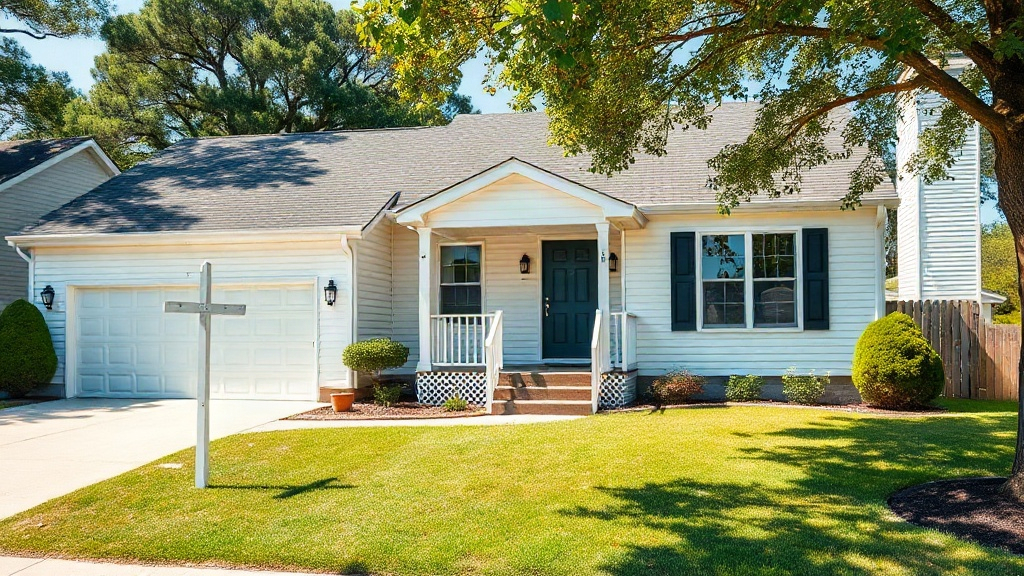
The 70% Rule: Your Fix & Flip Compass
The 70% rule is one of the most important guidelines for fix and flip investors. It helps you determine how much you can pay for a property while leaving enough room for renovation costs, holding expenses, and profit. The formula is simple: Maximum Allowable Offer (MAO) = (After Repair Value x 0.70) - Estimated Repair Costs. By sticking to this rule, you protect yourself from overpaying and ensure the deal has a built-in profit margin.
Want to skip the spreadsheet? FlipSmrt pulls comps, estimates ARV and rehab, and runs the deal math from just an address. Your first 3 analyses are free.
Let’s break it down. The After Repair Value (ARV) is the price the property is expected to sell for after renovations. The 70% multiplier accounts for all the other costs you’ll incur—closing costs, holding costs, and your desired profit margin—leaving 30% of the ARV as a buffer. Subtracting the estimated repair costs gives you the maximum price you should offer on the property. This keeps you disciplined, especially in competitive markets where emotions can drive up bids.
For example, if a property’s ARV is $300,000 and it needs $50,000 in repairs, the calculation would look like this: MAO = ($300,000 x 0.70) - $50,000. That equals $210,000 - $50,000, or $160,000. In this case, $160,000 is the most you should offer to ensure the deal is profitable. If you pay more, you’re risking a thinner margin and potentially losing money if unexpected costs arise.
The 70% rule is fundamental because it helps you account for the true costs of a flip, which are often underestimated by new investors. It also forces you to analyze deals based on math rather than emotion. While it’s not a perfect rule for every scenario (we’ll cover exceptions later), it’s a reliable starting point for most fix and flip deals.
By understanding and applying the 70% rule, you’ll approach deals with clarity and precision. It’s your compass for identifying profitable opportunities, and it naturally leads to calculating the Maximum Allowable Offer, one of the most critical numbers in any fix and flip strategy.
Worked Example: Calculating Maximum Allowable Offer (MAO)
The Maximum Allowable Offer (MAO) is a critical number for any fix & flip investor. It ensures you leave enough room for profit while covering all costs, including repairs and transaction fees. The formula is straightforward: MAO = (ARV x 0.70) - repair costs. Let’s break it down with a realistic example.
Imagine you’re evaluating a property with an After Repair Value (ARV) of $250,000. Based on your walkthrough and contractor estimates, the repair costs come to $50,000. Using the 70% rule, the calculation would look like this:
- Start with the ARV: $250,000
- Multiply by 0.70 to account for profit margin and other costs: $250,000 x 0.70 = $175,000
- Subtract the estimated repair costs: $175,000 - $50,000 = $125,000
In this scenario, your MAO is $125,000. This means the most you should offer on the property is $125,000 to ensure the deal remains profitable. Offering more than this could eat into your margins or even result in a loss once all expenses are accounted for.
To put this in perspective, the remaining $75,000 (30% of ARV) is your buffer. It needs to cover transaction costs (like closing fees and agent commissions), holding costs (utilities, insurance, and property taxes during the flip), and your target profit. If any of these costs are higher than expected, your profit shrinks. That’s why sticking to the MAO is so important—it protects your bottom line.
Using tools like FlipSmrt can speed up this process, helping you estimate ARV and repair costs more accurately. But even manually, the 70% rule and MAO formula are simple yet powerful tools to guide your offers. Never skip the math.
Estimating Profit: Breaking Down the Numbers
Estimating profit in a fix & flip deal requires a clear understanding of all the costs involved and how they stack up against the projected sale price. Many investors focus on the After Repair Value (ARV) and repair costs but forget about holding costs, selling costs, and other expenses that eat into the final profit. Let’s break this down with a worked example.
Suppose you’re considering a property with an ARV of $300,000. You’ve estimated $50,000 for repairs and negotiated a purchase price of $160,000. Using the 70% rule, your Maximum Allowable Offer (MAO) aligns with this purchase price: (ARV x 0.70) - repair costs = ($300,000 x 0.70) - $50,000 = $160,000. Now, let’s calculate the profit by factoring in all costs:
- Purchase Price: $160,000
- Repair Costs: $50,000
- Holding Costs: These include property taxes, insurance, and utilities during the rehab period. Let’s assume $1,500 per month for 4 months = $6,000.
- Selling Costs: Agent commissions (typically 6% of ARV) and closing costs. For an ARV of $300,000, that’s $18,000 in agent fees plus $5,000 in closing costs, totaling $23,000.
Adding these together, your total expenses are $160,000 + $50,000 + $6,000 + $23,000 = $239,000. Subtracting this from the ARV of $300,000 gives you a projected profit of $61,000. However, unexpected expenses can quickly erode this margin. For example, a delay in the rehab timeline or underestimated repair costs could add thousands to your budget.
To mitigate these risks, always build a contingency buffer into your repair budget (10%-15% is common). Additionally, thoroughly vet contractors, double-check permits, and confirm your ARV with recent comps. These steps can help you avoid surprises and protect your profit margin.
The takeaway: estimating profit isn’t just about the ARV and repairs. Include every cost, plan for contingencies, and keep your timeline realistic. This approach ensures that your projected profit aligns with reality when the deal closes.
Run these numbers on a real deal in under 5 minutes
FlipSmrt turns an address into ARV, a rehab budget, and your Maximum Allowable Offer automatically.
Analyze a Property FreeNuances and Edge Cases: When the 70% Rule Needs Adjusting
The 70% rule is a reliable baseline for most fix & flip deals, but it is not one-size-fits-all. In certain markets or property conditions, sticking rigidly to this rule can lead to missed opportunities or miscalculated offers. Two common scenarios that require adjustments are high-cost markets and properties with minimal rehab needs.
High-cost markets, such as San Francisco or New York City, often force investors to modify the 70% rule. In these areas, property prices are significantly higher, but percentage-based margins are tighter due to the competitive landscape. For instance, if the ARV of a property is $1,200,000, applying the standard rule (70% of ARV minus repairs) would result in a very low MAO. For example, if the rehab costs are $100,000, MAO = (1,200,000 x 0.70) - 100,000, which equals $740,000. However, in a market where homes are in high demand, you may find that buyers are willing to accept thinner profit margins, and adjusting to a 75% or even 80% rule could be more realistic. This means recalculating the MAO as $860,000 (80% of ARV minus $100,000). Always factor in the local market dynamics when making adjustments.
On the other hand, distressed properties requiring only light rehabs also warrant a different approach. If a property needs $15,000 in cosmetic updates and has an ARV of $250,000, the standard calculation would give you an MAO of $160,000 ((250,000 x 0.70) - 15,000). However, given the lower rehab risk and shorter timeline, it might make sense to use a higher percentage, such as 75% (MAO = $172,500). Lighter rehabs often justify a smaller margin because they reduce your exposure to cost overruns and holding expenses.
In both scenarios, the key is understanding the underlying trade-offs. High-cost markets and light rehabs both reduce risk in different ways—either through strong demand or limited renovation scope. By adjusting the 70% rule thoughtfully, you can remain competitive without sacrificing profitability. Just ensure you run the numbers rigorously and stay within your risk tolerance.
Common Mistakes: Over-Rehabbing and Misjudging Exit Timing
Two of the most expensive mistakes fix & flippers make are over-rehabbing a property and failing to account for market timing. Both can significantly eat into your profit margins if not managed carefully. These missteps often stem from either a lack of market research or overly optimistic projections. Let’s break down each mistake and how to avoid them.
Over-rehabbing happens when investors spend more on renovations than the market will reward. For example, if nearby comparable sales (comps) suggest buyers in the area are paying $300,000 for updated 3-bedroom homes, there’s little value in adding high-end finishes that push your costs up unnecessarily. Spending an extra $20,000 on luxury features like quartz countertops and premium fixtures won’t increase the After Repair Value (ARV) enough to justify the expense in a mid-market neighborhood. The key is to align your renovation budget with the expectations of local buyers. Study the comps and match the finishes to what’s selling. A $40,000 rehab that meets market expectations is often smarter than a $60,000 one that overshoots.
Misjudging exit timing is another costly error. Real estate markets move in cycles, and timing your flip poorly can mean holding a property longer than planned or selling in a downturn. For instance, if you buy in a hot market but delays push your sale into a cooling phase, you may face lower offers or longer days on market. To avoid this, build a buffer into your timeline for potential delays, such as contractor setbacks or permitting issues. Additionally, monitor local market trends closely. If inventory levels are climbing and prices are softening, it may be wise to price competitively and aim for a quick sale rather than holding out for top dollar.
To protect your profits, stay disciplined. Avoid the temptation to over-improve a property beyond what the market supports, and always factor in realistic exit timing based on up-to-date market conditions. These precautions can save you from costly mistakes and keep your fix & flip projects on track.
Fix & Flip FAQs: Quick Answers to Common Questions
What if my repair costs exceed estimates? This is a common challenge, and it highlights the importance of building a contingency buffer into your rehab budget. A good rule of thumb is to add 10-20% to your estimated repair costs as a safeguard against surprises. For example, if you project $40,000 in repairs, set aside an additional $4,000 to $8,000 to cover unexpected expenses. If costs still exceed your buffer, you may need to trim your profit expectations or explore ways to cut non-essential rehab costs without sacrificing market appeal.
How do I account for financing costs when calculating MAO? Financing costs, such as interest payments or points on a hard money loan, are not part of the traditional MAO formula. However, you should factor them into your broader deal analysis to ensure the flip remains profitable. For instance, if your financing costs are $12,000 on a $200,000 deal, subtract this from your expected profit. While MAO gives you a baseline for your offer, a full profit analysis (including financing) ensures you avoid surprises later.
What’s a good profit margin for a flip? Most fix-and-flip investors aim for a profit margin of at least 10-20% of the ARV. For example, if the ARV of a property is $300,000, you should target a minimum profit of $30,000 to $60,000. This range accounts for the time, effort, and risk involved. Keep in mind that market conditions, deal volume, and your personal financial goals may influence your target margin.
Can I still use the 70% rule in high-cost markets? In high-cost markets where profit margins are tighter, the 70% rule may not always apply. You might need to adjust to a 75-80% rule to account for higher purchase prices and thinner spreads. For example, in a market where ARVs average $800,000, a 70% rule might make it impossible to find deals, but using 75% could allow for more realistic offers while still leaving room for profit. Just make sure your math supports the adjusted margin.
How do I avoid over-improving a property? The key is understanding your target buyer and the neighborhood's expectations. Over-improving often happens when investors add high-end finishes to a mid-market property. For instance, installing $10,000 worth of custom cabinets in a $200,000 home likely won’t yield a proportional return. Focus on improvements that align with comparable homes in the area. Kitchens, bathrooms, and curb appeal upgrades tend to provide the best ROI without overspending.
Ready to analyze your next deal?
Get ARV, renovation estimates, and full deal math in under 5 minutes. Your first 3 analyses are free.
Start Free Analysis